Helping Every Child Find Their Voice
53 speech and language games that get harder as your child gets better — and a therapist-grade record of every turn they take. No scores shown to the child, no wrong answers on a quarter of the library, and nothing on the dashboard that isn't backed by evidence.
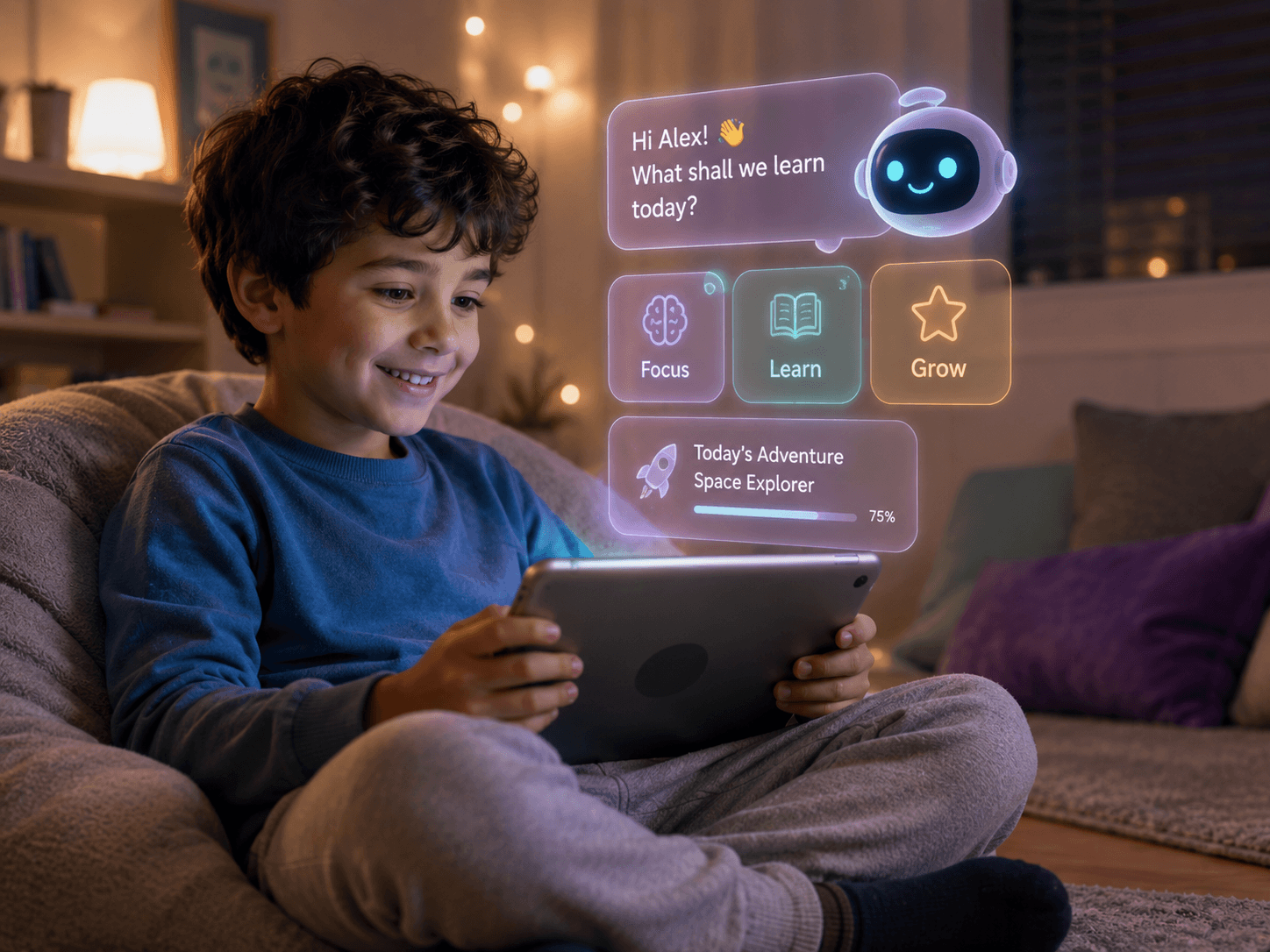
Independent
68% — up from 41%
“sun” mastered
3 sessions, 3 days
Feelings
not measured yet — 4 more turns
Parent Insight
New report ready
Built to the rules a speech therapist would recognise
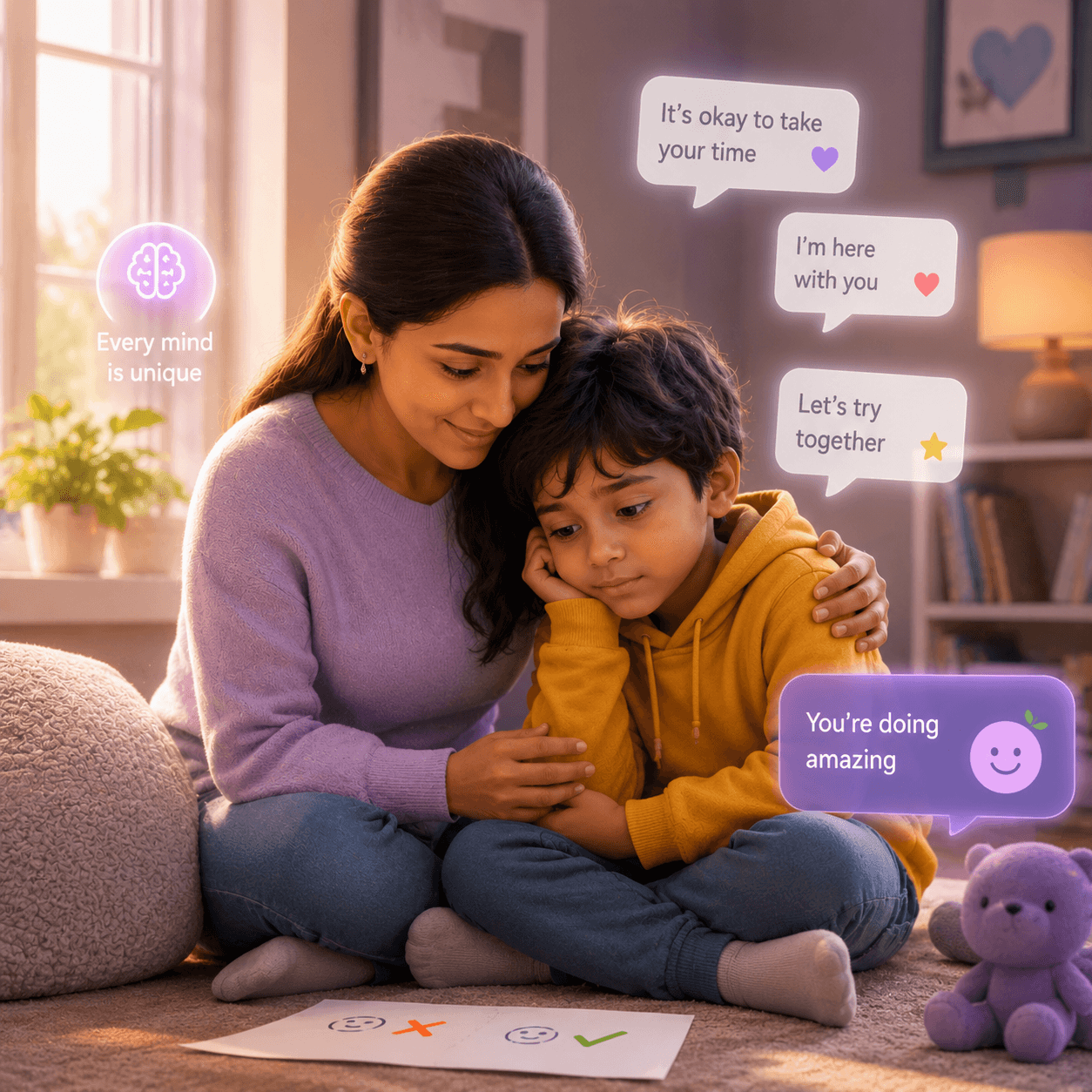
Communication Barriers Shouldn't Define a Child's Future
Millions of neurodivergent children face daily communication struggles. Current solutions are fragmented, inaccessible, and fail to meet them where they are.
Speech Delays
Many children struggle to form words, sentences, and express basic needs — leaving them frustrated and isolated.
Social Confidence
Difficulty reading social cues and engaging in conversations leads to anxiety and withdrawal from peers.
Limited Access to Care
Qualified speech therapists are scarce. Wait lists stretch months, and sessions are costly and brief.
Gap Between Sessions
Progress made during therapy fades without consistent, structured practice at home between appointments.
1 in 36
Children diagnosed with autism
75%
Show speech delays at diagnosis
6–12 mo
Average therapy waitlist
87%
Parents seek additional support
Meet Verbalyft
An AI-powered platform that transforms how neurodivergent children learn to communicate — with personalized exercises, real-time feedback, and support for every stakeholder.
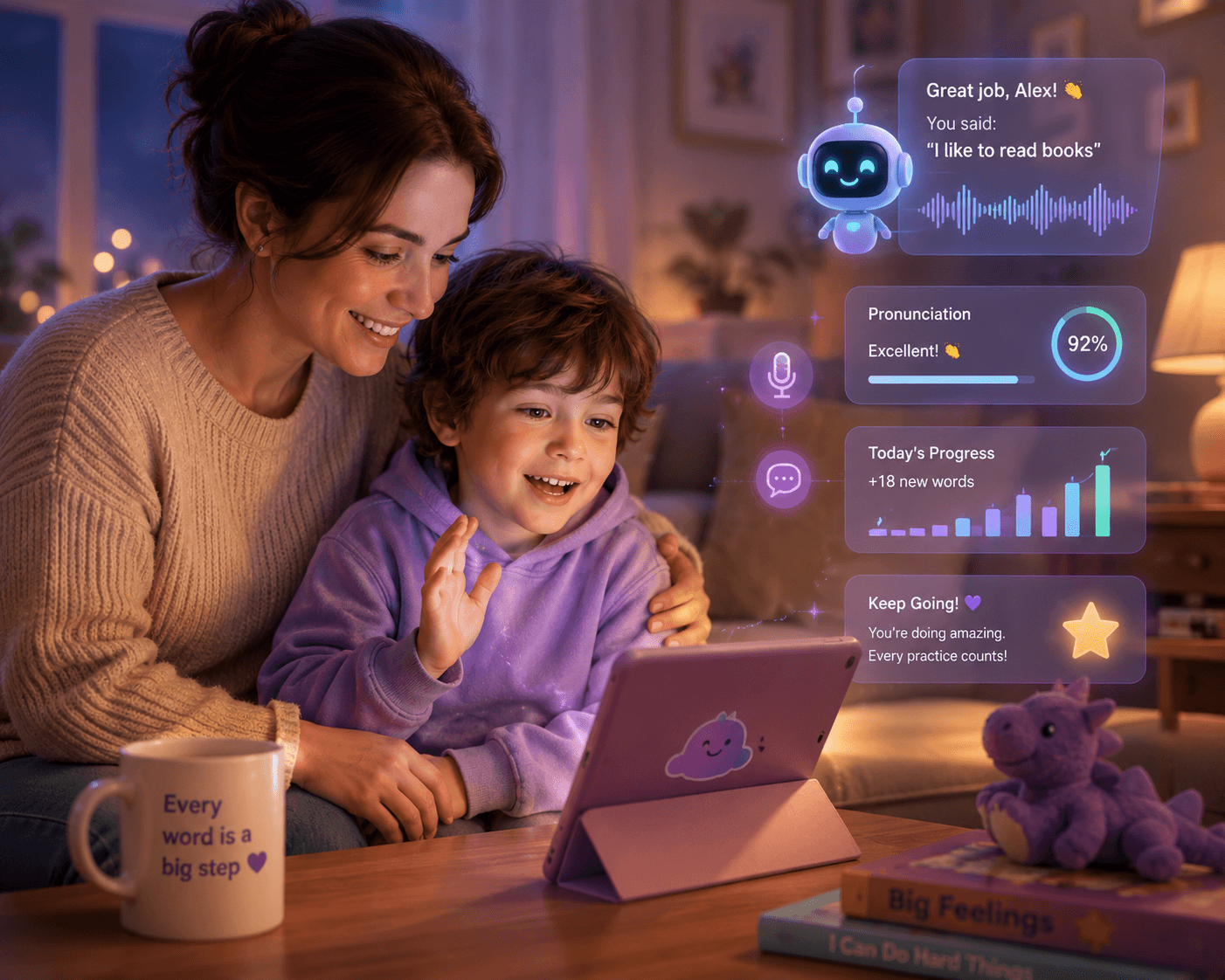
AI Speech Interaction
Real-time conversational practice with an AI companion that adapts to each child's speech level and pace.
Personalized Learning
Adaptive exercises shaped by the child's progress, interests, and therapy goals — no two journeys are alike.
Progress Tracking
Detailed analytics for parents and therapists, with milestone tracking and actionable insights over time.
Emotional Engagement
Gentle, encouraging interactions designed by child psychologists to build confidence, not pressure.
Home + Clinic Support
Seamlessly bridges therapy sessions and home practice, keeping the learning loop continuous.
Safe & Child-Friendly
COPPA-compliant, ad-free, and designed with child safety as the foundational principle.
53 games across 5 kinds of practice
Speech is not one skill, so the library is not one shelf. Listening, understanding, saying it, pretending, telling a story — a child who only ever practises one of those gets good at one of those.
Language & Thinking
Spot it, sort it, work it out



Find the Match · Simon Says · What's Missing? · I Spy · Sorting · Shape Sorter · +9 more
Speech & Communication
Ask for things, answer, chat

Choices · My Words · Yes or No · Sentence Builder · Snack Time · Feelings · +5 more
Sounds & Letters
Listen closely, then copy it

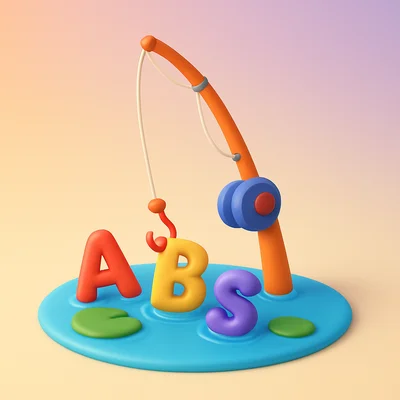

Tap Sounds · Sound Discovery · Sound Safari · Letter Play · Clap Along · Animal Safari · +4 more
Play & Pretend
Be someone else for a while




Bubbles · Peek-a-Boo · Freeze Dance · My Turn · Art Studio · Puppet Show · +4 more
Stories & Adventures
Read it, retell it, explore



Story Time · Story Questions · Tell the Story · Watch & Learn · Stories · Scramble · +1 more
Every game states how it is measured — including the ones that aren't
13 of the 53 are deliberately no-fail: there is no wrong answer to get wrong. An accuracy score for those is noise dressed up as a clinical finding, so we don't compute one — they are measured on engagement and turn-taking instead.
accuracy, first-try, what they reached for first
attempts and independence — never a machine verdict
engagement only; these cannot be got wrong
comprehension, sequencing, retell
symbol use and independence
53
games
every one recording trial-level data
11
clinical skill domains
reported separately — there is no blended score
4
developmental tiers
set by assessment, not by birthday
0
scores shown to the child
no percentages, no failure states
It gets harder at their pace, not on a schedule
Nobody picks a difficulty setting. Nobody has to notice when it stops being right.
A short assessment, not a birthday
Seven steps — three the grown-up answers, four the child plays. It measures how they communicate, what they understand, whether they copy you, and how long they last before attention goes.
Age tells us how long a sitting should be. It does not tell us how hard it should be — for a child with a language delay those two answers disagree, and seeding difficulty from age hands a delayed six-year-old a wall on their first screen.
Difficulty starts where they are
The assessment sets a floor, not a fixed level. A child never gets dropped below what they have already shown they can hold, and never gets opened on a grid they solved two years ago.
Every ladder in the app is ordered the same way, so a child does not start high in one game and low in another. How long the sitting runs is set separately, from age — 4 turns at three years old, 10 at seven.
It moves while they play
Right twice in a row and the next one is harder. Struggling and it eases back — faster than it climbed. Nothing announces any of this to the child.
It comes down quicker than it goes up on purpose. A child seeded too easy climbs out in a minute and enjoys doing it. A child seeded too hard is stuck on a screen they cannot pass, and leaves.
The same game tomorrow, until it sticks
A skill counts as learned at 80% first-try across three sessions on three separate days — so one lucky run cannot qualify. Until then, practice does not move on.
Then the same words appear in a different game. Getting it right in two places is what separates knowing the word from knowing the game.
You will stop choosing which games to play
Right now the library is open — every game, browse freely. That is the right way to launch and the wrong way to run therapy. For a child who finds choosing hard, the choosing is the demand, and the tablet often closes before an activity opens.
So we are building the plan instead. Three or four activities, chosen from what the assessment and their own turns already show — their strengths, what they find hard, which sounds and screens they can tolerate, and what you told us actually matters at home. Each one at its own level. In order. With a sentence saying why it is there today.
And it stays put. The same tiles tomorrow, because repetition is where mastery comes from and a plan that reshuffles every morning is its own kind of demand.
Today · 3 activities · about 9 minutes
Bubbles
Warm-up. She always wins this one.
→ 8 bubbles
Sound Safari
Day 3 of 5Found 4 of 5 “s” words first try, two days running. One more good day and this one's hers.
→ 4 pictures at a time
Animal Safari
New today. No wrong answers — she just makes the sound.
→ 5 animals
The level is in words, not numbers. A “level 2” you cannot interpret is decoration.
Built by the rules a therapist would recognise
Most of these are constraints rather than features — things the app deliberately will not do. That turns out to be what makes the data underneath it worth reading.
Parent-confirmed speech
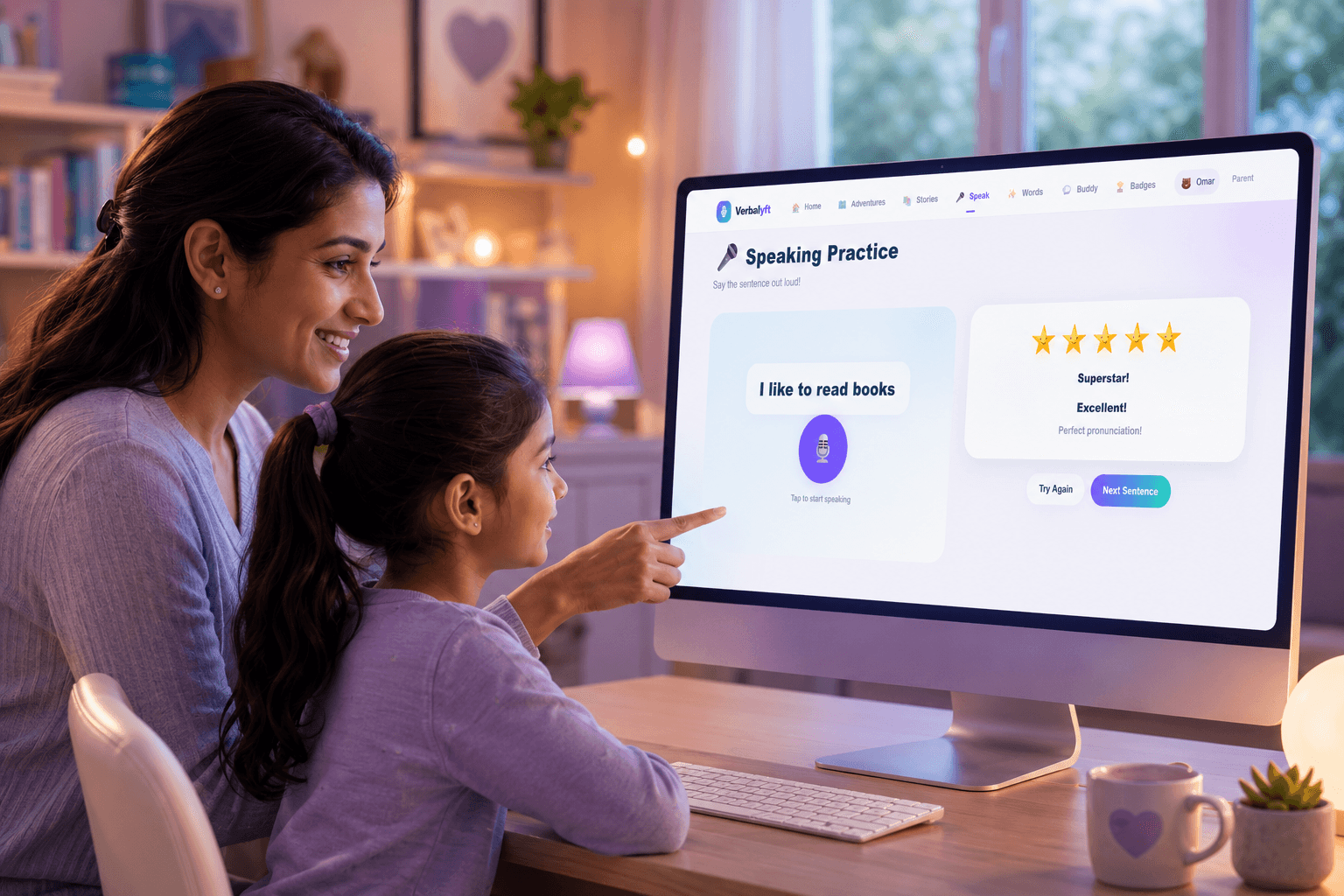
The microphone hears that a sound happened. You decide it counted. No child is ever told by a machine that they said it wrong.
Audio-first, always
Every instruction is spoken. Nothing in the library is locked behind being able to read, so a pre-reader can play it.
Word-level tracking
Not “played 12 games”. Which words, where the sound sat in the word, on how many separate days, and how many tries each one took.
Mastery that held up
80% first-try across three sessions on three separate days. One lucky run cannot qualify, and a word proven in two different games is marked apart from one proven in only one.
It says when it doesn’t know
A metric without enough evidence behind it reads “not measured yet”, and shows how many more turns it needs. Nothing is estimated to fill a gap.
How much help they needed
Six levels of prompting, from independent down to hand-over-hand. Right-every-time-alone and right-every-time-with-help are not the same child, and only this separates them.
Works when the wifi doesn’t
Turns are held on the device and land on the next app load — marked incomplete rather than lost, because stopping halfway is worth recording too.
One tap to prescribe
A therapist can put any activity on a child’s dashboard, regardless of the tier they were assessed into, and read the trials it produces.
Tablet, phone, or desktop
The same account on whatever is to hand. Most families use a tablet, and the whole library is built thumb-first for one.
Safe & private
COPPA-compliant, ad-free, encrypted. Nothing about a child is sold, and there is nothing in the app engineered to keep them on it longer.
You are not expected to already know how
Every game opens with two panels: what to actually do, and what to say while they do it. Here is a real one, word for word.
Catch the fish that starts with the sound you hear.
- 1Listen for the sound.
- 2Tap the fish whose name begins with it.
- 3Say the sound out loud as you catch it.
Written to the child, not about them — “find the picture”, never “ask your child to find the picture”. It reads correctly aloud to either of you, and only one of those two phrasings gives the child something to act on. An animation shows the gesture the first time.
Clear speech comes from practice volume — hearing and trying a sound many times, not perfectly.
If it's hard
You say it and they just point. Pointing still counts as a turn.
If it's easy
Use the word in a short sentence: “The sun is hot.”
No machine ever tells a child they said it wrong
Speech recognition reports only that a sound happened. You are the one who decides it counted, on a button — because a five-year-old told “incorrect” by a tablet stops trying, and the microphone is not good enough to be right about a child with a speech delay anyway.
Every instruction is read aloud
Written for a pre-reader to act on, and spoken in the same words that are on the screen. Nothing in the library is gated behind being able to read.
Sounds, never letter names
“sss”, not “ess”. Letter names are the most common way home practice accidentally teaches the wrong thing, so the app does not say them.
It tells you what to do when it goes wrong
Every game carries an “if this is hard” and an “if this is easy” line. The most useful moment for a parent is the one where the child is stuck, and that is exactly when generic encouragement is worth nothing.
Support Your Child's Growth Every Day
Five panels, plain language, one clear thing to try next. You should be able to read it in the thirty seconds you actually have, and come away knowing something you didn't.
This week
A seven-day strip, minutes practised, activities played. Not a streak you can break — a picture of the week you actually had.
Try this next
One suggestion, not nine. The highest-priority thing we found, in plain words, linking straight to the activity that addresses it.
What clicked
Words they have genuinely got. Marked ✦ when it held up in more than one game — which is knowing the word rather than knowing the game.
Still working on
The emerging set, framed as in progress. Never as failure, and never as a percentage.
Straight to the therapist
If your child has one, messaging is in the app and they are reading the same trial data you are.
No jargon, and no guessing
Where there isn’t enough evidence yet, the panel says so and says how many more turns it needs — instead of a zero that reads like failure.
4 words held up
across two different games
34 goals achieved
across 12 clients
Extend Your Impact Beyond the Clinic
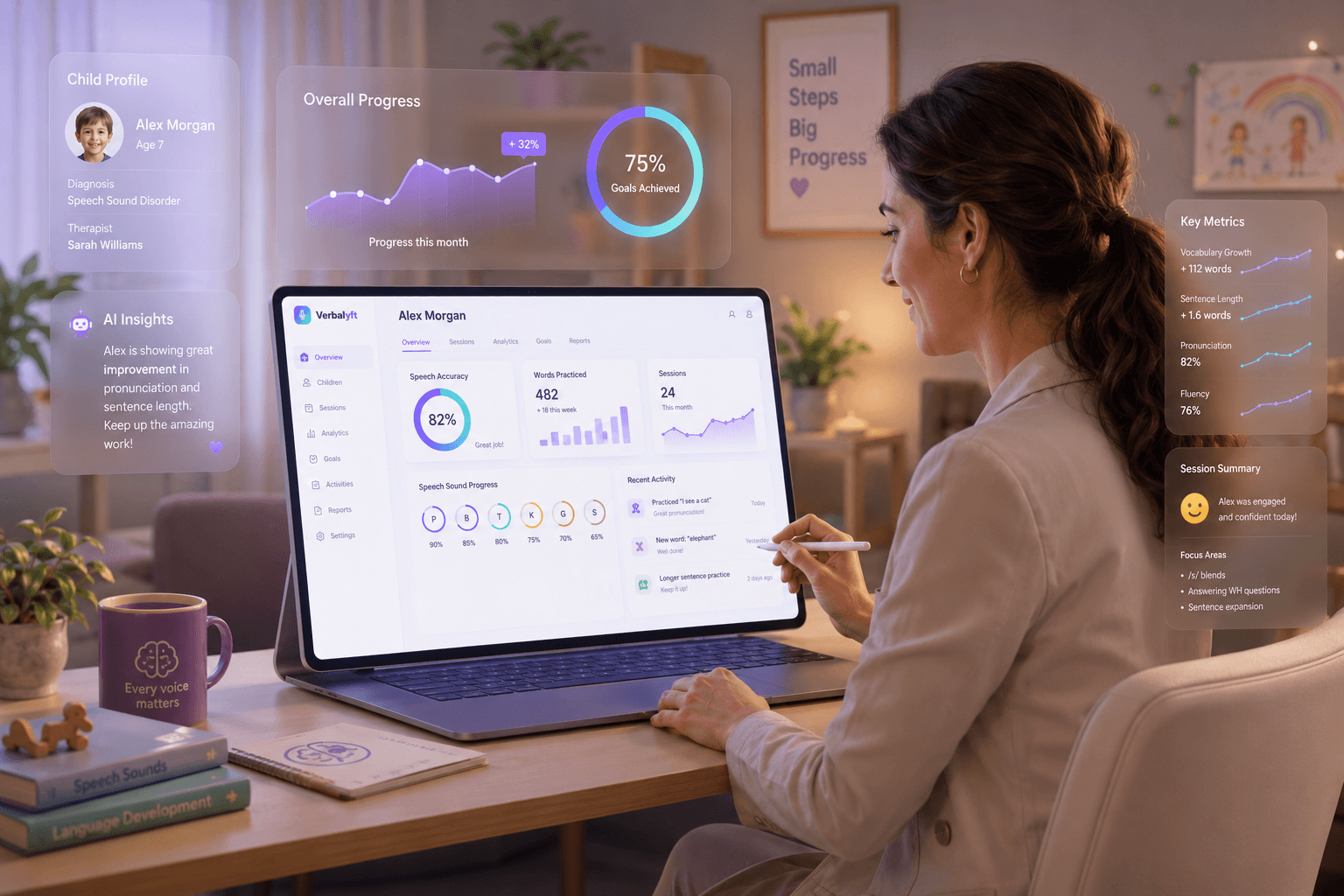
Every turn a child takes between sessions is recorded as a trial — what was asked, what they answered, how many tries it took, how much help they needed, how long they thought about it.
Caseload triage
Sorted by who needs you, not alphabetically. Last active, practice days, trials, percent-independent, first-try accuracy, targets mastered — and a dash where evidence is too thin to say.
Cueing hierarchy
Percent-independent across six prompt levels, with a four-week trend. The headline clinical metric, because accuracy alone cannot tell two very different children apart.
CSV export for progress notes
Trial-level data out, in the shape a note is written from. Nothing you have to retype, and nothing you have to take on trust.
Prescribe any activity
Assign anything in the library to a child and it appears on their dashboard, tier or no tier. Grouped by category, one tap.
Findings you can audit
Mastery, ready-to-level-up, prompt dependence, generalisation gaps, maintenance due, fatigue point, confusion pairs. Each carries its evidence and its n, so you can check it rather than trust it.
Per skill domain, never blended
Eleven domains reported separately, each with its own n. There is deliberately no composite score — a single number would imply a validated instrument that does not exist behind it.
Experience Interactive Learning
A preview of how children interact with Verbalyft every day.
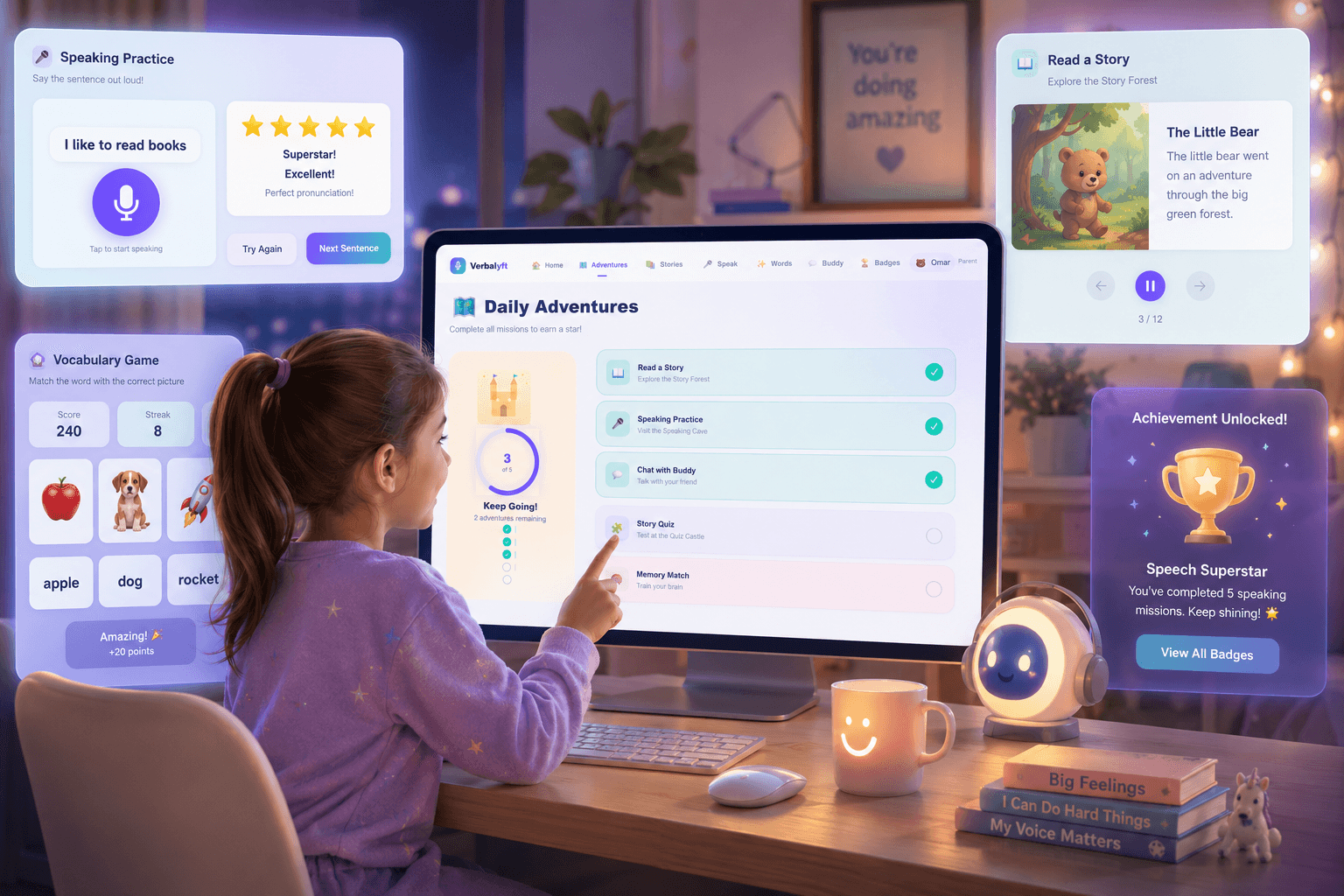
Listening...
We Are Opening to Our First Hundred Families
Verbalyft is new. We would rather tell you that than borrow somebody else's words for it. So the first hundred families get terms that nobody after them can.
Pay once, never again
One payment, and the price never changes on you — not at renewal, not when we put the price up for everyone after you.
Every game we ever add
53 games today across five kinds of practice. Everything we build after that lands in your account at no extra cost.
A direct line, not a queue
Founding families email the founder. What you ask for in the first year is what gets built in the first year.
Fourteen days to change your mind
The trial is free and takes no card. If you buy and it turns out not to fit your child, you get your money back. No questions.
Start with 14 days free — no card, and nothing to cancel if you walk away.
Simple, Transparent Pricing
Start free for 14 days. No credit card required. Cancel anytime.
Parent
Everything your child needs to practice at home.
- Unlimited speech practice sessions
- AI conversation companion
- Comprehension exercises
- Progress tracking & reports
- Personalized learning paths
- Multi-device access
- Safe, ad-free experience
Professional
For therapists and educators managing multiple children.
- Everything in Parent plan
- Up to 10 client profiles
- Therapist analytics dashboard
- Custom exercise creation
- Auto-generated progress reports
- Parent communication tools
- AI-assisted insights
- Priority support
Institute
For clinics, schools, and therapy centers at scale.
- Everything in Professional
- Unlimited client profiles
- Multi-therapist management
- Organization analytics
- Custom branding options
- API access & integrations
- Dedicated account manager
- SLA & compliance support
By continuing you agree to our Terms, including the 14-day no-questions-asked refund policy. Cancel any time — access continues to the end of the period you paid for.
Explore by sound, condition, and age
Free guides and practice activities — no account needed. Start wherever your question is.
By condition
All condition guides →
Every Child Deserves to Be Understood
We are opening to our first hundred families. Fourteen days free to see whether it fits your child — and no card until you decide it does.
14-day free trial · No credit card required · Cancel anytime